Retirement account guide
Gold IRA Rollover: How It Works, Rules, and Costs
A Gold IRA rollover lets you move eligible retirement savings into a self-directed IRA that can purchase qualifying physical precious metals. This guide explains which accounts may qualify, how transfers and rollovers differ, and what to review before choosing a custodian, buying metals, and arranging storage.
By George Risto · Updated September 2026
Affiliate disclosure: CaracalGold.com is reader-supported and may earn a commission from links on this page, at no extra cost to you.
Key takeaways
What Is a Gold IRA Rollover?
A Gold IRA rollover moves an eligible distribution from an existing retirement account into a self-directed IRA that permits physical precious metals. Once the funds arrive, the account can purchase qualifying gold, silver, platinum, or palladium. Moving the money and buying the metals are separate steps.
“Gold IRA” describes an IRA holding precious metals rather than a separate IRS account category. It can follow a traditional or Roth structure, which determines its tax treatment. Although providers sometimes use “rollover” broadly, moving an existing IRA directly between custodians is generally a trustee-to-trustee transfer.
Related: What is a Gold IRA?
Gold IRA Rollover vs. Transfer: What’s the Difference?
The funding method depends on where your retirement savings are held and how the payment is issued. Understanding the distinction helps you request the correct paperwork and avoid accidentally receiving a distribution you did not intend to take.
| Feature | Direct employer-plan rollover | IRA-to-IRA transfer | Indirect rollover |
|---|---|---|---|
| Movement of funds | Employer plan pays the receiving retirement account | Existing IRA custodian pays the receiving custodian | Distribution is paid to you for redeposit |
| Personal 60-day deadline | No | No | Generally applies |
| Once-per-12-month IRA rollover limit | Does not apply | Does not apply | Generally applies to IRA-to-IRA rollovers |
| Federal withholding | No mandatory rollover withholding | No withholding | Rules depend on the source account |
| Main consideration | Plan eligibility and receiving account type | Compatible account types and custodian instructions | Deadlines, withholding, and rollover eligibility |
These distinctions follow the IRS explanation of rollover methods.
Direct Rollover From an Employer Plan
A direct rollover sends an eligible employer-plan distribution to the receiving IRA. Your plan administrator may issue a wire or a check payable to the receiving custodian for your benefit. A check can still qualify as a direct rollover when delivered through you, provided it is correctly payable to the receiving account rather than to you personally.
Trustee-to-Trustee IRA Transfer
An IRA transfer moves assets directly between custodians without distributing the money to you. The receiving custodian generally supplies instructions and may help submit the request. Confirm whether both accounts have the same tax designation, because moving pretax savings into a Roth IRA can create taxable income.
Indirect 60-Day Rollover
An indirect rollover pays the distribution to you, making you responsible for completing an eligible redeposit. Before choosing this method, understand the deadline, applicable withholding, and whether a previous IRA rollover affects eligibility. A failed rollover can leave some or all of the distribution taxable.
Which Retirement Accounts Can Fund a Gold IRA?
Several retirement account types may provide eligible funding. The available method depends on the source account, its tax treatment, and any distribution restrictions. Your current administrator and receiving custodian should confirm eligibility before you request payment.
| Existing account | What the page should explain |
|---|---|
| Traditional IRA | Transfer into a traditional self-directed IRA |
| Roth IRA | Maintaining Roth status in the receiving IRA |
| Former-employer 401(k) | Eligibility for a distribution and direct rollover |
| Current-employer 401(k) | Plan-specific restrictions on distributions during employment |
| 403(b) | Eligible distributions and administrator requirements |
| Governmental 457(b) | Applicable rollover options; distinguish nongovernmental plans |
| TSP | Distribution eligibility and receiving-account instructions |
| SEP IRA | Transfer options and account compatibility |
| SIMPLE IRA | Special rules, including the initial two-year period |
Can You Roll Over a 401(k) While Still Employed?
Possibly, but your plan must permit an eligible distribution while you remain employed. Some plans allow certain in-service distributions after age 59½, while others impose different restrictions. Reaching that age does not automatically give every employee access to a rollover. Ask the plan administrator whether a full or partial distribution is available.
How to Complete a Gold IRA Rollover
Confirm Your Existing Account Is Eligible
Identify your account type, whether the balance contains pretax or Roth money, and whether you can take an eligible distribution. For an employer plan, contact its administrator before opening a receiving account. Confirm any restrictions, outstanding loan issues, or payments that must remain outside the rollover.
Compare Gold IRA Companies and Custodians
Request written information about purchase pricing, account fees, storage, and buyback terms. Identify the dealer, custodian, and depository separately. The dealer sells metals, the custodian administers the IRA, and the depository stores the assets. Customer assistance from a dealer does not replace the custodian’s account responsibilities.
Open Your Self-Directed IRA
Complete the custodian’s application, provide identification, and name your beneficiaries. Make sure the traditional or Roth designation matches your intended transaction. Review the account agreement, fee schedule, and available storage arrangements before signing. Keep a copy of the account number and official funding instructions.
Request the Transfer or Direct Rollover
Use instructions supplied by the receiving custodian to request payment from your existing provider. Check the receiving account name, account number, payee details, and delivery address. Ask both institutions how to track progress and who will contact you if documents are missing or the payment requires correction.
Review Pricing and Purchase Eligible Metals
Wait until your custodian confirms that funds are available. Obtain an itemized quote showing the product, quantity, unit price, and total purchase cost. Confirm that the exact products qualify for IRA ownership. Review the dealer’s current buyback quote or pricing method before authorizing the purchase.
Confirm Storage and Account Records
Verify that the metals reach the agreed depository and appear correctly in your account records. Retain purchase confirmations, storage details, and fee disclosures. Review statements periodically and keep enough liquidity available for ongoing expenses and any withdrawals you expect to take.
Compare providers before starting your rollover.
Gold IRA Rollover Rules and Tax Considerations
When the 60-Day Rule Applies
When an eligible distribution is paid to you, you generally have 60 days from receipt to complete the rollover. Missing the deadline can create a taxable distribution, although limited relief may apply.
When the Once-Per-Year Rollover Limit Applies
The limit generally applies to indirect IRA-to-IRA rollovers across your IRAs during a 12-month period. It does not apply to trustee-to-trustee transfers or employer-plan-to-IRA rollovers. IRS rollover rules.
Employer-Plan Withholding vs. IRA Withholding
Taxable eligible employer-plan distributions paid to you generally have 20% mandatory withholding. IRA distributions follow different withholding rules. Do not assume the employer-plan percentage applies to every withdrawal.
Traditional-to-Traditional Moves vs. Roth Conversions
A properly completed move between compatible pretax accounts generally preserves tax deferral. Converting pretax money to a Roth IRA generally creates taxable income.
Distributions That Cannot Be Rolled Over
Required minimum distributions and certain other payments, including employer-plan hardship distributions, are ineligible. Confirm eligibility before requesting payment. IRS tax guidance.
Hypothetical example — withholding on an indirect rollover
Say you request a $50,000 indirect rollover from a former employer’s 401(k). The plan is generally required to withhold 20% ($10,000) for federal taxes, so you receive $40,000. To complete a full tax-free rollover within 60 days, you must deposit the entire $50,000 into your new IRA — replacing the withheld $10,000 from other funds — and recover the $10,000 when you file. Redeposit only the $40,000 and the missing $10,000 is generally treated as a taxable distribution, with a possible early-withdrawal penalty if you’re under 59½. Figures are illustrative.
Gold IRA Rollover Fees and Ongoing Costs
The cost of moving retirement savings into precious metals extends beyond opening the account. Your existing provider may charge an outgoing fee, while the new arrangement can involve administration, storage, and trading expenses. Ask for a complete written schedule before authorizing the move.
| Cost | When it may apply | What to ask |
|---|---|---|
| Outgoing account fee | Moving or closing the existing account | Does my current provider charge an exit fee? |
| Setup fee | Opening the receiving IRA | Is this charged separately or waived? |
| Custodian fee | Ongoing administration | Is pricing flat or based on account value? |
| Storage fee | Holding physical metals | What storage arrangement and insurance are included? |
| Dealer premium | Purchasing coins or bars | What is the total price for each product? |
| Buyback spread | Selling metals | How does the buyback quote compare with the purchase price? |
| Transaction or shipping fee | Specific account activities | Which additional services carry charges? |
How to Compare the Total Cost
Compare written quotes for identical products and quantities. A company offering free account setup may still charge higher metal premiums or ongoing expenses. Check how long fee waivers last, which charges they cover, and what applies afterward. Ask about selling, shipping, transferring, and closing the account as well.
How Long Does a Gold IRA Rollover Take?
There is no universal completion time. Opening the receiving IRA, processing the distribution, clearing funds, purchasing metals, and confirming storage are separate stages. The source institution’s procedures and payment method can affect the schedule.
Ask each provider for an estimate covering its part of the process. Keep track of the payment status and follow up if documents or account details require correction. An account being open does not mean its funding or metal delivery is complete.
Common causes of delay
Which Precious Metals Can You Buy After a Rollover?
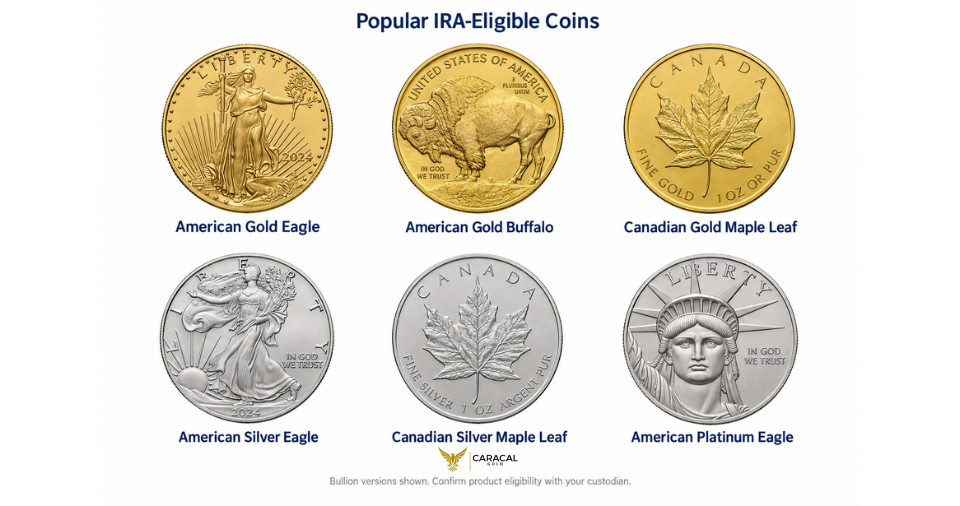
Once funding is complete, your IRA can purchase eligible products supported by the custodian. Review both product qualification and pricing before placing an order.
Eligible Gold, Silver, Platinum, and Palladium
Qualifying bullion generally requires minimum fineness of 99.5% for gold, 99.9% for silver, and 99.95% for platinum and palladium. Certain coins qualify under statutory exceptions, including American Gold Eagles. Purity alone does not establish eligibility, so confirm the exact coin or bar before buying.
Where Your IRA Metals Are Stored
Your custodian arranges compliant custody, commonly using a precious metals depository. Review the storage agreement, insurance terms, and whether holdings are segregated or stored under another arrangement. Taking personal possession can create distribution consequences.
Benefits and Risks of a Gold IRA Rollover
Potential benefits
Risks and trade-offs
Is a Gold IRA Rollover Right for Your Retirement Goals?
Consider how physical metals would fit alongside your other savings, expected expenses, and retirement timeline. Gold may provide diversification, but it does not guarantee protection against inflation or market declines. Review how much liquidity you need, how fees affect the account, and whether the move would leave too much of your savings concentrated in one asset.
Common Gold IRA Rollover Mistakes to Avoid
How to Choose a Gold IRA Rollover Provider
Look for clear documentation, responsive service, and pricing you can compare. A provider should explain the process without guaranteeing returns or pressuring you to move quickly. Confirm which institution administers the IRA and who handles funding questions, product purchases, storage records, and future sales.
See also: Best Gold IRA Companies · Augusta Precious Metals Review
Gold IRA Rollover FAQs
Can I Roll Over Only Part of My Retirement Account?
An eligible partial rollover may be possible, depending on your account and plan rules. It can let you move a portion of your savings while leaving the remaining balance in place. Ask your administrator about partial-distribution options, minimum balances, and any charges before submitting a request.
Is a Gold IRA Rollover Tax-Free?
A properly completed rollover into a compatible account generally avoids an immediate tax bill on eligible funds. However, converting pretax savings into a Roth IRA generally creates taxable income. Ineligible distributions or an incomplete indirect rollover can also have tax consequences. The source account and receiving account both matter.
Do Rollovers Count Toward Annual IRA Contribution Limits?
Eligible rollover amounts do not count toward the annual limit for regular IRA contributions. This allows qualifying retirement balances to move even when they exceed that limit. New cash contributions remain subject to separate eligibility and contribution rules. Your custodian should record each type of funding correctly.
Can I Move a Roth IRA Into a Gold IRA?
You can generally transfer a Roth IRA to a self-directed Roth IRA whose custodian supports eligible precious metals. The receiving account must preserve the appropriate Roth designation. Confirm the account registration before moving funds; a Gold IRA’s name alone does not establish whether it is traditional or Roth.
What Happens If I Miss the 60-Day Deadline?
The amount not validly rolled over may become taxable, and an additional early-distribution tax may apply depending on your circumstances. Limited waiver or relief provisions exist, but eligibility is not automatic. Contact your custodian and a qualified tax professional promptly if you believe a deadline has been missed.
Is There a Minimum Amount for a Gold IRA Rollover?
There is no single provider-wide minimum. Custodians and dealers can establish their own account or purchase requirements. Ask whether the advertised minimum applies to opening the IRA, buying metals, or qualifying for a promotion. Consider the effect of fixed annual charges on the amount you plan to move.
Can I Take Physical Possession of the Gold?
You may be able to request an in-kind distribution through your custodian, subject to its procedures and applicable tax rules. Receiving the metals personally is a withdrawal from the IRA, rather than continuing IRA storage. Confirm the valuation, reporting, shipping charges, and potential taxes before arranging delivery.
How Do I Sell Metals or Take Withdrawals Later?
Contact your custodian to understand its sale and distribution procedures. You may sell metals through a dealer and withdraw cash, or request an available in-kind distribution. Compare buyback quotes and allow time for processing. Taxes depend on the account type, your circumstances, and whether the withdrawal meets applicable requirements.
Ready to Compare Gold IRA Providers?
Compare account requirements, written purchase prices, storage arrangements, and ongoing fees before moving retirement funds. Our company comparisons can help you identify the questions to ask and review the available services.
Informational use only: This page is not financial, tax, or legal advice. Rules change and individual situations differ — consult a licensed professional before acting.
